
Franklin County Criminal History Checks
A useful Franklin County record search begins by defining the question. Call the Regional Jail for present local custody. Ask the arresting agency for an incident or arrest narrative. Use CourtNet and the Circuit Court Clerk for filed charges, hearing activity, and disposition. Choose the Kentucky State Police process when an official state compilation is the actual goal. These sources can disagree without any one of them being false, because each records a different event at a different time.
Gather a full name, any known spelling or alias, an approximate event date, and a case or report number if one is available. Date of birth can help the custodian distinguish people with similar names, but do not place unneeded private data in an open-records letter. Use identity documents only when a form or official asks for them.
- Call the Franklin County Regional Jail for current custody, or identify the police agency that made the arrest.
- Create a free CourtNet account and search the statewide public court index for a Franklin County case.
- Call Circuit Court Clerk Kem Marshall's office when a certified copy, signed order, or older file is needed.
- Request the narrative from the sheriff, Frankfort Police, KSP Post 12, or Kentucky State University Police, based on who made the report.
- Use the KSP name check or fingerprint-based personal review when the request calls for an official Kentucky criminal-history product.
Franklin County Court Records After Flood
The April 2025 Kentucky River flood closed the courthouse on St. Clair Street and made record location a live issue. Clerk functions later moved to the AOC campus at 1001 Vandalay Drive, while many criminal proceedings were held at the Franklin County Regional Jail. The courts returned to the courthouse in September 2025, but court-authorized drying, remediation, secure storage, and retention-based destruction of damaged files continued.
The Franklin County Court of Justice page is the source for the current clerk location and contact details.
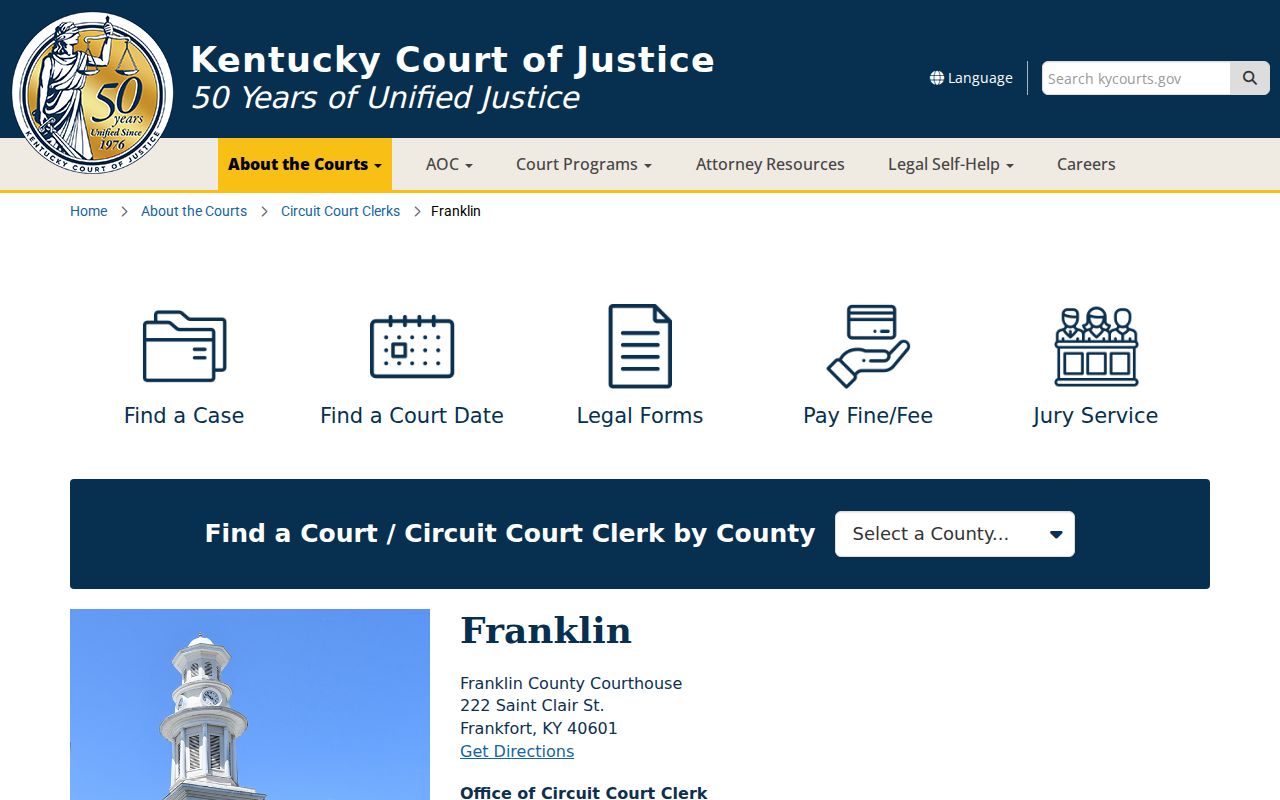
The court image helps confirm the official access point, but readers with a deadline should still call the clerk because old flood notices may remain online.
For an older public file, begin with the clerk rather than the State Records Center. The clerk supplies the case number and offsite file-locator number. A name or Social Security number cannot replace those locator details at the archive. That local sequence prevents a wasted records request and keeps the Franklin County case tied to the court that owns it.
Official Background Checks in Kentucky
Kentucky State Police, Criminal Identification and Records Branch, maintains the central criminal-history repository. The general-public Kentucky name check is not an open web search. KSP accepts the proper form by mail or at its counter, charges $20, requires the subject's permission, and states an average mail time of about ten business days. Payment is by check or money order to the Kentucky State Treasurer. The name-based product uses no fingerprints and should not be confused with a certified Franklin County judgment.
Authorized fingerprint checks begin through IdentoGO. A person reviewing their own Kentucky record can instead follow 502 KAR 30:070 with KSP Form 309, rolled fingerprints, and the stated fee. If the review finds an error, KSP Form 310 starts the challenge process. The Franklin County Sheriff separately lists $10 per fingerprint set. Program-specific directions control, so use the exact form required by the agency that authorized the fingerprint check.
The KSP background-check forms index confirms the current forms and mail-only status.

The form page is the safest starting point because KSP uses separate forms and instructions for different authorized record requests.
Note: A Kentucky court search cannot replace an identity-matched KSP review or a certified Franklin County judgment.
CourtNet Is Not Franklin County History
CourtNet, Kentucky eCourt's Find a Case service, exposes statewide court entries and dockets to public users with free accounts. It may show e-filed documents or scanned images when access rules allow. Sealed cases do not appear, confidential matters need authorization, and protected images may be limited to parties. The interactive login also means there is no defensible public inventory of every search control, so a Franklin County search should not rely on guessed fields.
A CourtNet result is a court database entry, not a Kentucky rap sheet. A District Court felony-charge matter may first carry an “F” case type. If an indictment follows, the felony moves to a Circuit Court “CR” case. Searching only one number can miss part of the path. “M” identifies a District misdemeanor case, while “T” refers to traffic. Read the original charge, any amendment, and the final disposition together.
- F case
- The District Court felony-charge and probable-cause stage, not a finding of guilt.
- CR case
- The Circuit Court criminal case that follows an indictment or information.
- Disposition
- The recorded outcome of a charge, which may include dismissal, plea, acquittal, or conviction.
- Certified copy
- A clerk-authenticated court record, distinct from a screen result or statewide compilation.
Kinds of Criminal Records
One Franklin County event can produce several records. The officer writes an incident or arrest report. Jail staff create booking and custody data. The prosecutor decides what charge to pursue, and the clerk keeps the court file. Fingerprint-supported arrest information can enter KSP's central repository. These are linked systems, but none is a substitute for all the rest.
- Police or sheriff report: the agency narrative, alleged offense, event details, and response.
- Booking record: jail intake, custody status, intake charge, fingerprint, and bond or release data.
- Court case file: citation or indictment, motions, orders, hearings, judgment, and sentence.
- State criminal history: the KSP compilation built from qualifying identity, arrest, and disposition reporting.
- Special systems: warrant activity, KOOL custody or supervision, and the KSP registry each answer narrower questions.
Frankfort Police Central Records also keeps accident reports, citations, criminal reports, incident reports, and parking tickets. Franklin County records outside city police jurisdiction may instead belong to the sheriff or a state agency. The record owner matters more than the building closest to the event.
Franklin County Jail Records and KOOL
Franklin County Regional Jail at 400 Coffee Tree Road keeps current local booking and custody records. Its official site did not expose a stable, crawlable public roster during research, so the reliable public fallback is the automated inmate-information number at 502-875-8782. A focused records request may seek releasable booking data that is not shown online. The jail itself warns that a charged person is presumed innocent.
KOOL, the Kentucky Online Offender Lookup, covers state prisoners and people under Kentucky Department of Corrections supervision. It does not list everyone held at the county jail. Searchers can use a name or exact DOC/PID number, then narrow by supervision status, location, Franklin County of supervision, dates, conviction county, offense, or KRS code. KOOL advises using few fields because one wrong filter can hide the right result. Newly entered data may not be final for 120 days.
The KSP criminal-history overview shows why a repository check answers a different question from jail or KOOL custody.

The source comparison supports a simple rule: use the jail for local custody, KOOL for state custody or supervision, and KSP for a state history product.
VINE adds notification when custody status changes. It does not supply the officer's arrest report or the court disposition. Franklin County probation and parole are also state-run through DOC District 12, not a county supervision department. Verify a judicial sentence with the court file, then use KOOL or the district office for the public DOC status.
Note: A person can leave the Franklin County jail channel yet appear later in KOOL after state transfer.
Franklin County Criminal Records: What They Contain
Fields depend on the source. An official criminal-history compilation can connect identity data to reported arrest cycles, charges, and dispositions. A Franklin County court file adds procedural detail, while an agency report adds the event narrative. The public KSP name product is conviction-oriented and permission-based. A fingerprint-supported personal review offers a stronger identity match.
| Name and identifiers | Names, aliases, birth information, and agency or system numbers used to distinguish the record subject. |
|---|---|
| Arrest and booking data | Arresting agency, intake date, presented charge, custody status, and bond or release information when public. |
| Charges and statutes | Original and amended allegations, case type, and the Kentucky statute linked to each filed count. |
| Disposition | The outcome for each charge, read with its date and the signed Franklin County order or judgment. |
| Sentence | Custody, probation, financial entries, and later revocation activity recorded by the court. |
| Custody or supervision | Separate jail or KOOL status that can change after the court event. |
Kentucky's broad offense classes are capital, Class A through D felonies, Class A and B misdemeanors, and violations. Franklin Circuit Court handles felony and capital cases. District Court hears misdemeanors, traffic, ordinances, violations, and felony preliminary stages. The class alone does not prove the actual sentence, since offense-specific rules and the signed judgment control.
Franklin County Warrant Verification Chain
No verified public Franklin County active-warrant database was found. That gap is not a reason to trust an unofficial people-search page. Call the Sheriff's Office at 502-875-8740, check CourtNet case activity, and contact the Circuit Court Clerk at 502-564-7013. A targeted request may help when the record is public. District Court is often the source for misdemeanor or failure-to-appear matters, while Circuit Court handles felony cases. Sealed warrants, sealed indictments, and juvenile matters will not be public.
Franklin County Sheriff's Office warns that it does not call to announce a warrant, does not collect warrant payment by phone, and has no “warrant and citation division.” Text-A-Tip is a tip channel, not a warrant-confirmation service. A person concerned about their own status should verify through the official chain and seek legal advice before taking a step that could affect liberty.
Note: Court activity can suggest a warrant, but the sheriff or issuing court must confirm its current status.
Kentucky Public Access Laws
The Kentucky Open Records Act lets qualifying requesters seek nonexempt public agency records by delivery, mail, fax, or email to the named custodian. The agency must give a written response within five business days. That is a decision or status deadline, not a promise that every file will arrive in five days. A denial must cite the exemption and explain why it applies. If the request reaches the wrong agency, the Act calls for notice of the proper custodian.
Key Kentucky statutes:
KRS 61.872 sets the inspection and request process for nonexempt public records.
KRS 61.878 lists exemptions that can support withholding or redaction.
KRS 61.880 governs written responses and the Attorney General appeal route.
KRS Chapter 17 separately controls criminal-history and registry dissemination.
Active investigations, juvenile records, sealed court files, protected victim details, and other confidential material may be withheld or redacted. Court files also follow judiciary access rules. Ask for a defined record, date range, report or case number, format, and delivery method. Broad requests are harder to route and more likely to sweep in protected material.
Franklin County Sheriff Report Requests
Sheriff Dwayne F. Depp's office uses its own request form. Send the completed PDF to openrecordsfcso@franklincounty.ky.gov. The office emails the total, and payment is due before mailing. A sheriff accident or case report costs $5. Photo media up to 700 MB costs $15 per CD or thumb drive, with additional document pages at $0.10 each. Mailed accident or theft reports need a self-addressed stamped envelope.
The official Franklin County Sheriff's Office page identifies the agency and its current public contact.
The sheriff source belongs with unincorporated-area agency reports, not with a Frankfort Police narrative or a clerk-held judgment.
| Franklin County item | Published amount | Request route |
|---|---|---|
| Sheriff accident or case report | $5 | FCSO form and email |
| Photo media up to 700 MB | $15 | FCSO form, prepaid |
| Additional sheriff document page | $0.10 | FCSO, after fee notice |
| Fiscal Court paper copy | $0.10 | County custodian |
| Specific noncommercial electronic record by email | No charge | Fiscal Court channel |
Fiscal Court at 321 W. Main Street is the administrative fallback, not the owner of every police record. Its channels include email, fax, mail, and counter service. The county open-records instructions explain those choices.
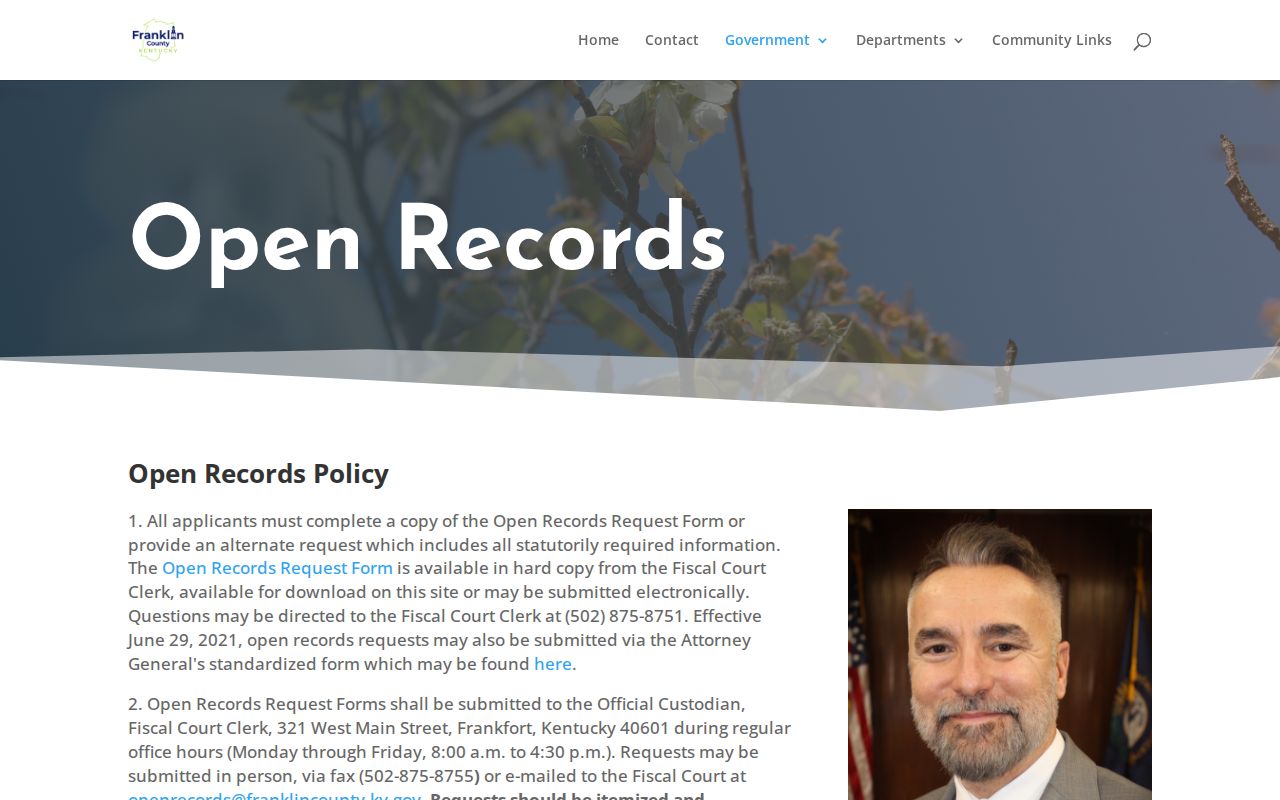
The county page helps route administrative records, while incident narratives must still go to the agency that created them.
Restricted, Sealed & Expunged Records
Sealed and confidential Franklin County court records do not become public because a person searches several systems. Juvenile material, protected victim details, active investigative records, and other statutory categories may also be restricted. A missing CourtNet result can reflect a legal restriction, expungement, reporting delay, or search mismatch. It is not proof that an event never occurred.
Kentucky defines expungement as removal or deletion that prevents qualifying records from appearing on official state-performed checks. Eligible conviction cases begin with an AOC certification. Dismissals and acquittals on or after July 15, 2020 are generally expunged automatically after 30 days, except traffic cases, but that rule does not cover every case. The signed order and each named agency's later response provide the best verification chain.
Note: An old private copy may persist even after qualifying Franklin County records disappear from official state-performed checks.
Franklin County Expungement Certification
The Kentucky process starts with a $40 certification. An online applicant creates an account, pays by major credit or debit card, and downloads the packet after notice. A mail applicant completes RU-009 and sends the form with a check or money order to the AOC Records Unit at 1001 Vandalay Drive in Frankfort. The correct petition or application then goes to the county where the charge was filed, which means Kem Marshall's clerk office for a Franklin County matter.
The Kentucky Court of Justice expungement page provides the certification and filing sequence.
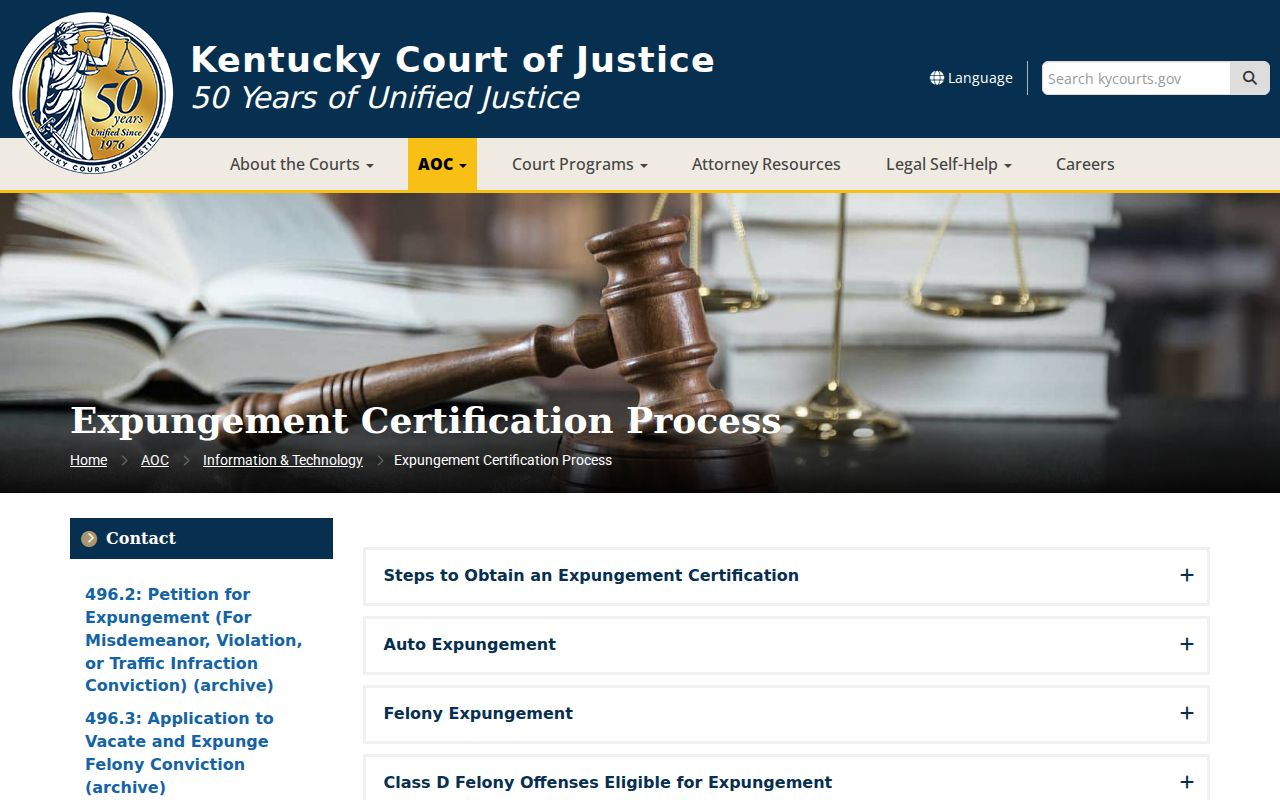
The official page matters because Kentucky uses different AOC forms for eligible felony, misdemeanor, and dismissal or acquittal matters.
An eligible felony filing totals $300 after certification: $50 is nonrefundable at filing and $250 is due after the court grants relief, with installments allowed. The prosecutor has 60 days to object. Distribution of an order can include KSP, the arresting agency, prosecutor, and local jail. A person who needs another agency notified should identify that need to the court within the stated period.
City-by-City Criminal Records in Franklin County
Frankfort is Franklin County's only incorporated city, so one city guide matches the local government structure. Frankfort Police writes city incident and arrest reports, Central Records keeps five named paper-file categories, and the City Clerk accepts open-records requests. Frankfort has no city jail and no separate modern municipal court. City arrests go to the Regional Jail, while ordinance, misdemeanor, traffic, and felony preliminary matters go to Franklin District Court.
Frankfort Record Check
Frankfort Police records, city request routes, county booking, and District Court case access.
Franklin County Prosecutors Split Charges
Kentucky does not use one “district attorney” for every Franklin County criminal case. Commonwealth's Attorney Larry Cleveland handles felony prosecution in Circuit Court. County Attorney Max Comley handles District Court and local prosecution. That split helps explain why an intake allegation can change as a case moves from arrest to probable-cause review and, when indicted, to a Circuit Court file.
The Department of Public Advocacy's Frankfort Trial Office at 223 St. Clair Street represents qualifying people accused of crimes or facing a loss of liberty. Its location across the courthouse area also reflects how closely Franklin County case access, prosecution, defense, and clerk records connect. Still, each office keeps its own work product, and the clerk's signed judgment remains the authoritative public court outcome.
Arrest allegation → jail booking → prosecutor review → District Court preliminary stage → Circuit Court after indictment → disposition and sentence.
Note: The charge shown at jail intake may be amended, dismissed, or replaced before the Franklin County case ends.