
Criminal Court Cases in Franklin County
Franklin County is both the 48th Judicial Circuit and the 48th Judicial District. Circuit Court has felony and capital jurisdiction. District Court hears misdemeanors, violations, traffic matters, local ordinances, felony arraignments, and probable-cause hearings. That split matters when a search starts with a charge. A felony may first appear as an “F” case in District Court. After indictment, the prosecution moves forward as a “CR” case in Circuit Court. One name can therefore lead to two linked records without reflecting two convictions.
The Franklin County court information page identifies Circuit Court Clerk Kem Marshall as custodian for Circuit, Family, and District Court records. The normal counter is at 222 St. Clair Street, Frankfort, KY 40601. It is open weekdays from 8 a.m. to 4 p.m. Call 502-564-7013 or fax 502-564-8188. The clerk is the right source for a certified docket, signed judgment, or local file that an online view cannot supply.
The Kentucky Court of Justice describes Circuit Court jurisdiction on its official court page.
This state court view helps place felony files in the correct Franklin County court before a docket or judgment is requested.
Franklin County District Court Charges
District Court is not just a misdemeanor court. It also handles the first stages of a felony charge, including arraignment and a probable-cause hearing. Franklin County local rules list arraignments Monday through Thursday at 9 a.m. They place misdemeanor trials on Tuesday at 10 a.m., with motions and felony examining trials at 1 p.m. Tuesday. Those published times are useful orientation, but the 2025 flood changed court sites and schedules for months. Confirm a live hearing date with the clerk rather than relying on an old calendar.
A standalone misdemeanor normally stays in District Court. A misdemeanor joined in a felony indictment may remain with the Circuit Court case. The official District Court description confirms its role in misdemeanors, violations, traffic, ordinances, and felony preliminary proceedings.
The District Court source explains why the first Franklin County felony docket may not contain the final felony disposition.
Franklin County Case Record Searches
Begin with CourtNet for a statewide electronic lead, but finish at the Franklin County clerk when the outcome must be proved. The public interface requires a free account. Search access can include electronic case entries, e-filed documents, and scanned images, subject to Kentucky court access rules. The account gate prevented a defensible capture of every field and dropdown. The table therefore reports only the controls and access facts verified in the research.
- Open CourtNet “Find a Case” and create the required free public account.
- Search the available public case and docket records with known party or case information.
- Check the case type. An “F” record may lead to a later “CR” case after indictment.
- Read the docket with the original charge, amendments, disposition, and dates in view.
- Call the Franklin County clerk for the signed judgment, certified copy, missing image, or offsite file.
| Verified access item | Type | Required | Franklin County use |
|---|---|---|---|
| Public account | Login | Yes | Required before public record and docket searching |
| Case entries | Electronic record | No | Use as a lead to a District or Circuit case |
| E-filed documents | Document image | No | Available only when access rules permit |
| Scanned images | Document image | No | Protected images may be limited to parties |
| Case and file locators | Clerk-supplied numbers | For offsite files | Needed by the State Records Center |
When CourtNet does not expose the needed image or older entry, use the clerk’s phone or counter instead of guessing at a hidden search control.
CourtNet Access in Franklin County
CourtNet and Kentucky eCourt “Find a Case” is a statewide court database, not a Kentucky rap sheet. It can help connect a Franklin County name or case number to the court docket. It cannot turn a database entry into a certified judgment. Sealed cases do not appear, confidential cases require entitlement, and protected images may be limited to parties even when a public docket entry is visible.
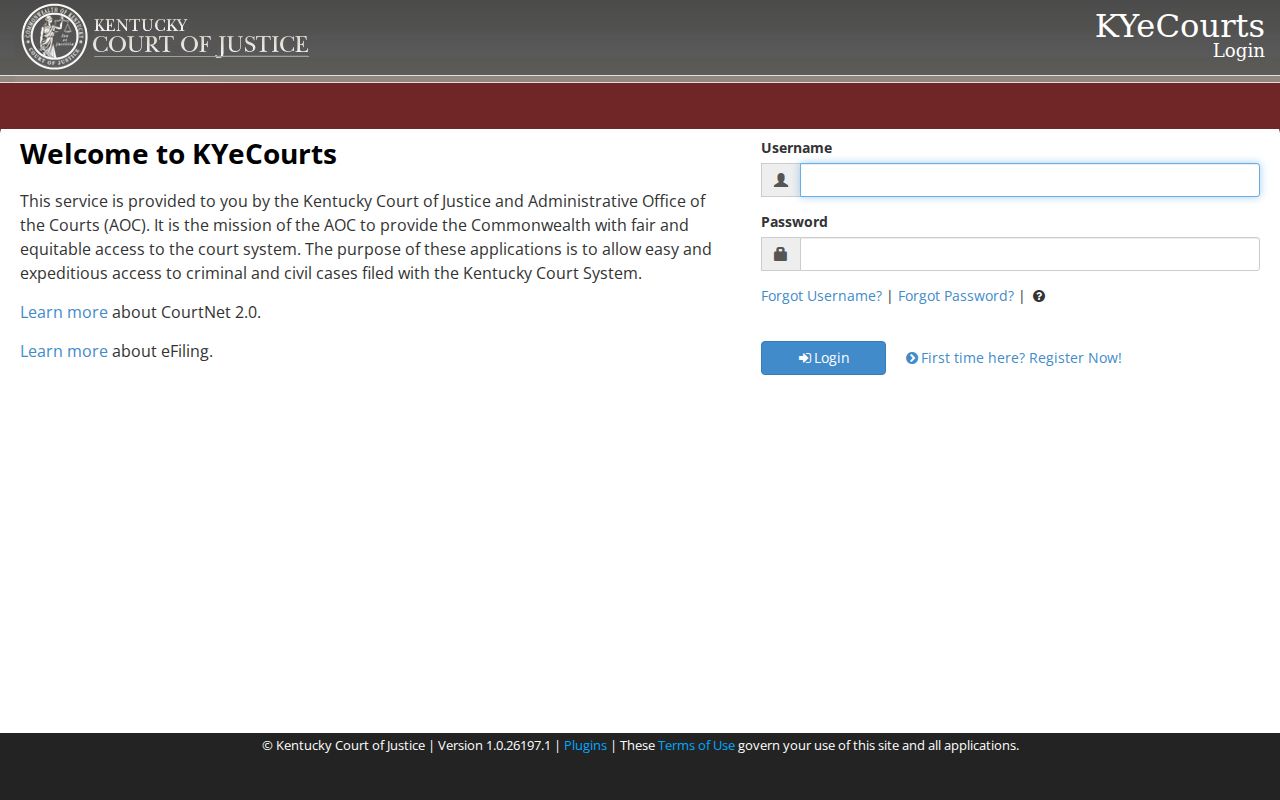
The login screen marks the start of the online search, while the Franklin County clerk remains the source for the official local file.
Kentucky’s separate AOCFastCheck product also should not be confused with CourtNet or a certified file. Its statewide $25 report may show “T,” “M,” “F,” and “CR” cases, with original charges, amendments, disposition dates, and clerk memos. It carries the notice that it is not an official court record. Expunged or county-purged matters do not appear. When exact proof matters, request the filed document from Franklin County.
Note: A CourtNet result identifies a court entry, while the signed judgment from the Franklin County clerk establishes the authoritative local outcome.
What a Criminal Case File Contains
A Franklin County case file records the legal path after an allegation reaches court. It may contain a citation, complaint, indictment, pleadings, motions, orders, docket entries, evidence, reports, hearing records, video, or transcripts when those items apply. Not every public electronic view exposes every document. A reader trying to understand the result should focus on the charging document, amended charges, disposition, and signed judgment rather than a lone early docket line.
| Case Number and Court | Identifies the District “F,” “M,” or “T” matter, or the Circuit “CR” case and filing court. |
|---|---|
| Charging Document | Shows the citation, complaint, information, or indictment that put charges before the court. |
| Docket Entries | Chronicle filings, hearings, motions, pleas, orders, and other case events. |
| Hearing Dates | Show scheduled proceedings, but current dates should be confirmed with the clerk. |
| Disposition and Judgment | Record how each charge ended; the signed judgment is the authoritative result. |
| Sentence and Conditions | State the court’s sentence and public terms, subject to later orders or appeals. |
The Kentucky court-record request page explains that local clerks hold case files and that older records may move to a records facility.
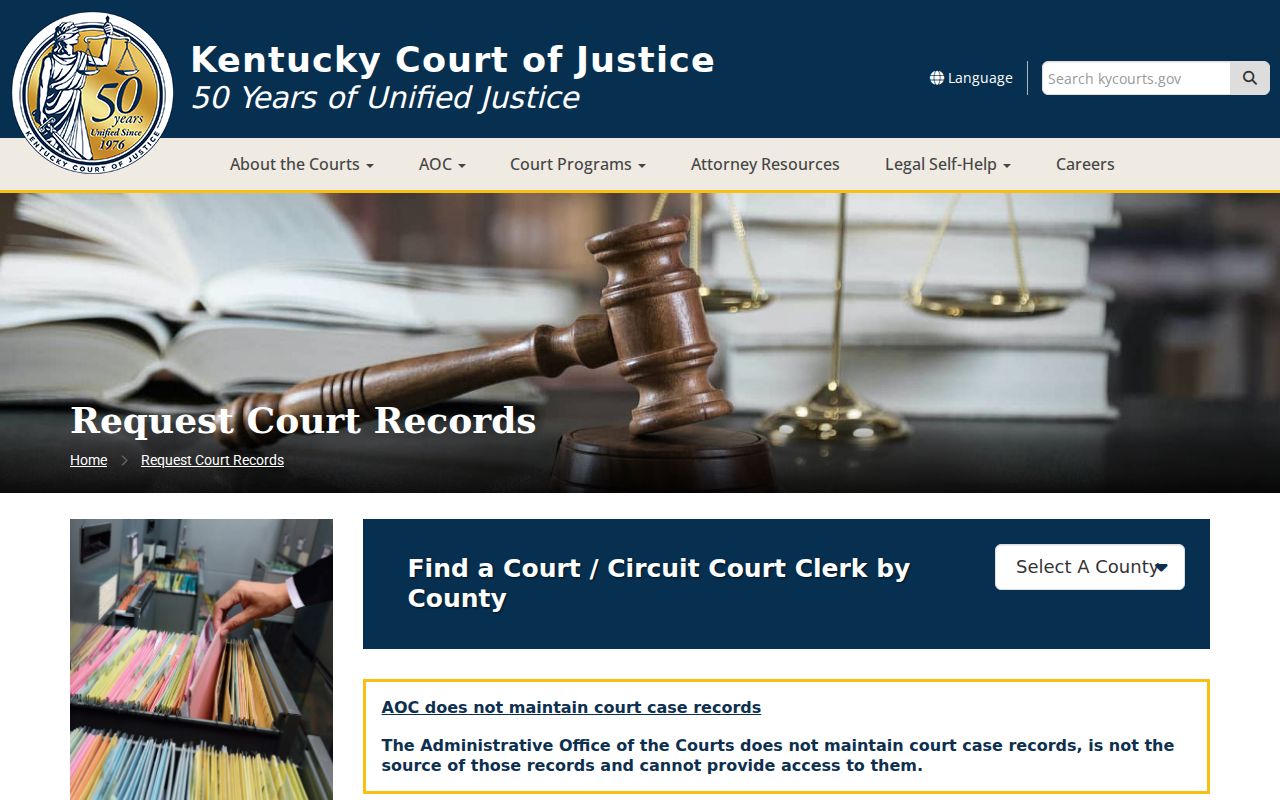
This request route matters when a Franklin County docket lacks an image, certification, transcript, or older paper document.
Flood-Damaged Franklin County Court Files
Kentucky River flooding began on April 5, 2025 and seriously damaged the St. Clair Street courthouse. The clerk and some courts shifted to the Administrative Office of the Courts campus at 1001 Vandalay Drive in June. Many criminal proceedings remained at the Franklin County Regional Jail. An official Kentucky Court of Justice notice records the September return after nearly five months, while file remediation continued.
The Supreme Court later authorized approved vendors to dry, remediate, securely store, or destroy damaged records under retention schedules. That does not mean every missing file was destroyed. It means an older Franklin County record may need added retrieval work. Start with the clerk. If a public file is offsite, ask for both the case number and file-locator number. The State Records Center cannot replace those locators with a name or Social Security number.
Criminal Case Stages in Franklin County
A Franklin County case can change as it moves from the accusation to a final order. Prosecutors may decline a charge, amend it, or seek an indictment under a different statute. District Court handles the preliminary felony record. Circuit Court takes the felony after indictment. Motions, plea talks, or a trial then shape the docket before disposition and sentence. The filed charge is therefore more useful than the booking allegation, and the final judgment is more useful than either one.
Case flow: Charges Filed → Arraignment → Pretrial → Plea or Trial → Disposition → Sentencing
Franklin County also splits prosecution by court level. Commonwealth’s Attorney Larry Cleveland handles felony Circuit Court prosecution, while County Attorney Max Comley handles District Court and local prosecution. The Department of Public Advocacy’s Frankfort Trial Office, at 223 St. Clair Street and 833-385-6051, serves eligible people accused of crimes or facing loss of liberty.
A dismissal, acquittal, amendment, guilty plea, or conviction must be read charge by charge. Eligible Franklin County dismissals or acquittals on or after July 15, 2020 are generally expunged automatically after 30 days, excluding traffic matters. Conviction cases follow the separate Kentucky certification and petition process. The broader Franklin County arrest search explains why an intake charge and filed court charge may differ.
Reading Franklin County Criminal Labels
Kentucky’s labels are procedural shortcuts, not verdicts. “F” marks a District Court felony-charge or probable-cause case. If an indictment follows, “CR” identifies the Circuit criminal case. “M” marks a District misdemeanor case, while “T” is traffic. A person can therefore have an “F” entry that ends as the matter shifts to a “CR” case. The first record should not be read alone.
- Arraignment
- The hearing where the accused is told the filed charge and enters an initial plea.
- Probable cause
- The preliminary finding that allows a felony charge to proceed toward grand-jury action.
- Disposition
- The recorded result for a charge, such as dismissal, acquittal, plea, or conviction.
- Indictment
- The formal grand-jury charging document that starts the Circuit “CR” prosecution.
Kentucky also groups felonies as capital or Classes A through D, while misdemeanors are Class A or B. Circuit Court handles felony cases. District Court handles standalone misdemeanors. The class describes a statutory range, not the result in a particular Franklin County judgment.
The AOC report lists original charge, amended charge, and disposition as separate fields. Read all three. A certified Franklin County judgment is the best source when an abbreviation or clerk memo remains unclear.
Access Rules for Case Records
Public access has limits. Sealed Franklin County cases do not appear in CourtNet. Confidential cases require entitlement, and protected images can remain party-limited. Juvenile records, protected victim information, and material covered by a court order or law may be withheld or redacted. An absent online result does not prove that no case exists. It may reflect access status, retention, an offsite file, a name mismatch, or expungement.
Ask the clerk about the exact case and document. The clerk, not AOC central, is the first custodian of a locally filed court record. A request can identify the court, approximate date, case number if known, document type, preferred format, and need for certification. If the file moved, get its locator. If the clerk says it is sealed or confidential, an open-records demand does not override the judicial restriction.
The Kentucky Open Records Act in KRS Chapter 61 governs executive-branch public records, but court records also operate under judiciary access rules. It does not make AOC central the custodian of every Franklin County file.
Office of Circuit Court Clerk
222 St. Clair Street
Frankfort, KY 40601
502-564-7013
Weekdays, 8 a.m. to 4 p.m.
Federal Court Cases in Frankfort
Federal charges do not appear in Franklin County CourtNet. Franklin County lies in the Eastern District of Kentucky, Frankfort Division. The federal courthouse is the John C. Watts Federal Building, 330 West Broadway, Frankfort, KY 40601, and its listed phone is 502-223-5225. PACER is the official federal docket and document system. It requires registration and charges under its current fee schedule.
The Eastern District’s Frankfort Division page confirms the local federal office and contact.
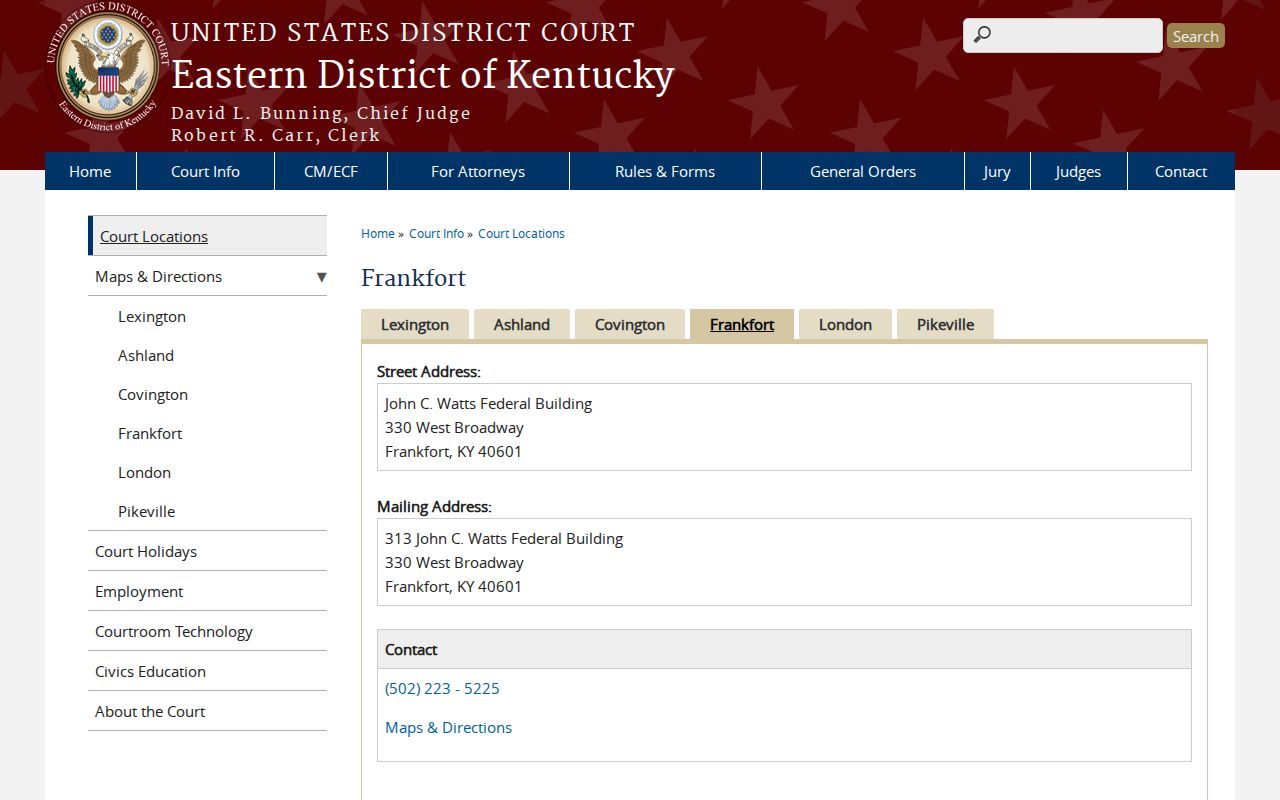
This federal source separates cases filed in U.S. District Court from those maintained by the Franklin County Circuit Court Clerk.
PACER can show docket numbers, counsel, event text, public filings, judgments, sentencing documents, and available PDFs. Sealed documents and protected identifiers remain unavailable or redacted. A federal prison lookup also belongs to the Bureau of Prisons, not the county jail or Kentucky Online Offender Lookup.